My Story
I didn't set out to become a coach. For much of my life, I was simply trying to survive.
I spent nearly two decades in addiction and ended up living out of my car. I rebuilt my life and became Vice President of Sales at a global technology company. Then that success started breaking my body. Everything I teach comes from finding my way back from both.
A difficult beginning
As a first-generation American raised by two World War II survivors — my German father and Japanese mother — I grew up in a home shaped by discipline, resilience, survival, and unspoken trauma. I struggled to understand that world, and by age eleven I had already turned to alcohol and drugs. By my teens, I was reckless, cutting class, and constantly in trouble.
At fifteen, a girl I loved was accidentally shot and killed by a friend. I had seen her that night and begged her to stay with me. For years, I carried the belief that if I had convinced her, she might still be alive.
Pain became rage, and rage fed an addiction that would control nearly two decades of my life.
Pain that gets passed down
I'll never forget the phone call from my girlfriend's sister at the hospital, telling me she was gone. My father stood nearby as I broke down. All he said was, "Oh, that's too bad," before walking away. To him, death was familiar. To me, it was unbearable.
Decades later, as he was dying of cancer, my father finally told me why he couldn't face that moment. As a boy in Germany, he had found his best friend, a neighbor girl, dead in the rubble after a bombing. My pain had triggered his.
Hearing that gave me a strange kind of closure. Full circle. It also taught me something I teach today: pain that isn't faced gets passed down.
Addiction and rock bottom
By nineteen, I was a full-blown addict. For nearly two decades, addiction ran my life. I was in and out of jails, institutions, and rehab programs. I overdosed once. Eventually, I lost everything.
When there was no one left to take me in, I lived out of my car along Highway 1 north of Santa Cruz, sleeping by the beaches and surviving one day at a time. Every day was a hustle just to get high and maybe eat.
Underneath the drugs was something darker. For years, I was suicidal, and I tried to end my life more than once. My life was one failure after another. I destroyed everything around me: my relationships, my family's trust, every chance anyone gave me. The people who loved me most got hurt the most. I truly believed I was a burden to my family and to society.
That belief felt like the truest thing I knew. It was a lie. I'm still here, and the life I have today is proof.
If you're in that place right now, call or text 988, the Suicide & Crisis Lifeline. It's free and open 24/7.
Change or die
At 38, I reached the turning point. I knew I had to change or die. I chose recovery.
Sobriety was the hardest fight of my life. For three years, I went to NA and AA faithfully. Then I spent two years in weekly counseling, because sometimes meetings aren't enough. That's when I really began to face myself.
The first years felt like climbing out of hell with no rope. I wasn't just quitting drugs. I was rebuilding myself from nothing. As Dr. Joe Dispenza teaches, if you want to change your personal reality, you first have to change your personality.
I had to rebuild my identity. That became one of the foundations of the work I teach today.
Success that nearly broke me
As I rebuilt my life, I built a career. I worked my way up to Vice President of Sales for a global X-ray technology company serving military, aerospace, automotive, electronics, and medical-device manufacturers. I had gone from living in my car to an executive role in a highly technical industry.
But I traveled two to three weeks every month, and ten-hour days were normal. After about five years at that pace, my body paid the price: severe acid reflux, a hiatal hernia, anxiety, restless sleep, and stress-related hair loss.
The doctors prescribed medication, and I found myself depending on pills to cope. After everything I had overcome, I recognized a familiar pattern.
I had learned how to be successful. I hadn't learned how to be successful without sacrificing myself.
One day, I gathered my prescriptions and threw them away. I don't recommend anyone stop prescribed medication without medical supervision. For me, that moment marked my decision to find a different way to live.
That was the moment I decided to take my health — and my life — back.
Taking my health back
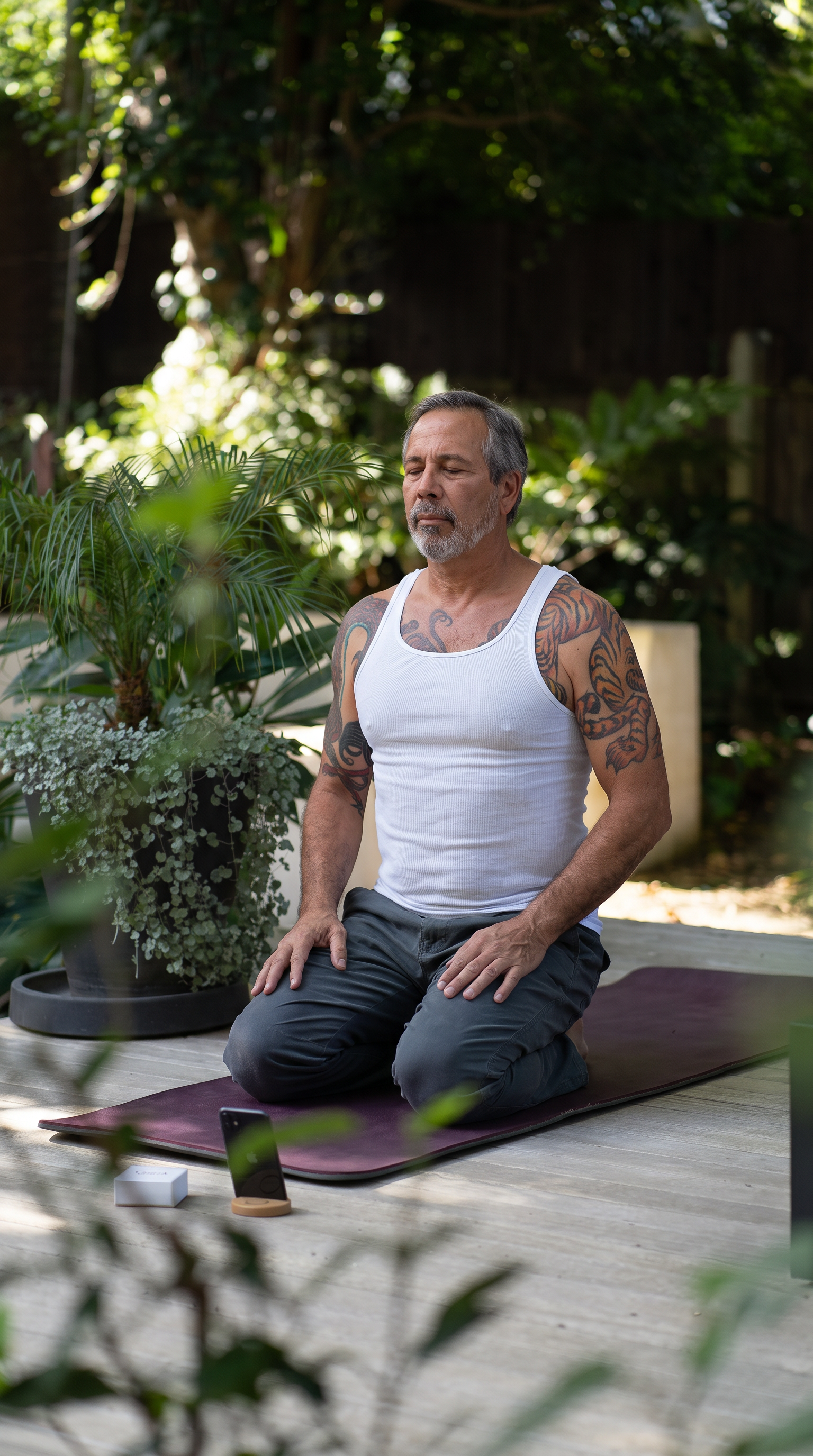
More than a decade ago, my search led me to Qigong. It became a lifeline. Through breath, gentle movement, and focused attention, I began changing how I responded to stress. For the first time, I was working with my body instead of fighting it.
I've completed 200 hours of Qigong teacher training, and I'm still taking courses. I now teach Qigong, and I'm certified in Dan Brulé's Breath Mastery system.
Outside formal training, I've pushed myself wherever I could, from walking on fire at Tony Robbins events to T. Harv Eker's Warrior Camp.
Along the way, I learned something important. Breathwork can change how you feel in the moment. Lasting change takes more: repetition, self-awareness, healthy habits, movement, and the willingness to practice every day.
Turning experience into a method
I built Everyday Warriors to be the program I wish I'd found decades earlier: not a few hours of inspiration, but a clear, daily process for rebuilding your body, your mind, and your life. It's for anyone who looks fine on the outside but is struggling on the inside. I understand that place because I've lived it.
Every part of the 12-Week Life Reset comes from something I had to learn the hard way. It's built on five pillars:
- Physiology: Breath and movement that build your capacity to handle stress.
- Psychology: Facing old pain so it stops running your life.
- Identity: Rebuilding who you are, not just what you do.
- Execution: Daily practice, one day at a time, until it holds.
- Warrior Philosophy: Rising again after every fall.
The Way is in training.
The life I live now
Today, 24 years into recovery, my life is beyond anything I could have imagined. I have a wonderful wife, amazing stepchildren, and a grandson who lights up my world. I travel to places I never dreamed I'd see.
The work never stops. Every day, I still show up to practice, to learn, and to fight for the man I want to be.
Because being a warrior isn't about perfection. It isn't about never falling. It's about rising, again and again, no matter how many times life knocks you down.
I am an Everyday Warrior. And so are you.
Maybe your story sounds like mine. Or maybe your life just isn't where you want it to be, and you're ready for real change. Either way, I'm proof it can be done. Let's talk.
Your past is part of your story. It doesn't have to be the end of it.
Training and experience
- 01
Founder of Everyday Warriors
- 02
Creator of the 12-Week Life Reset
- 03
Certified in Dan Brulé's Breath Mastery system
- 04
200 hours of Qigong teacher training, still training
- 05
More than a decade of Qigong practice
- 06
Several years teaching Qigong
- 07
Former Vice President of Sales
- 08
Military, aerospace, automotive, electronics and medical-device manufacturing
Your next chapter can be different.
You don't have to become perfect. You have to become willing — willing to look honestly at your life, practice differently, and take the next step.
Everyday Warriors is coaching, not medical care or addiction treatment. If you're in active addiction, start with treatment first.